YOU’VE GOT TO BE TOUGH TO BE AN AGOUTI
Author: Jack Ewing
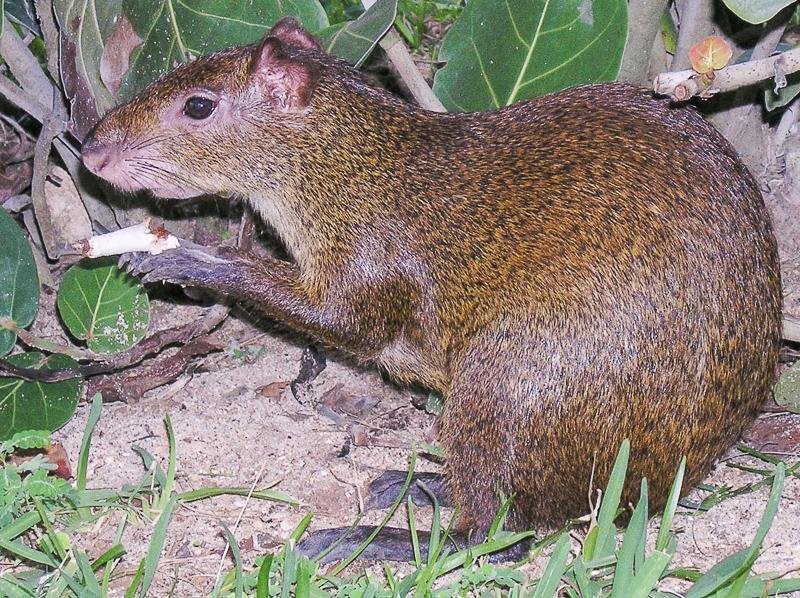
When you’re walking through the rainforest and surprise an animal that goes bouncing through the undergrowth emitting panicked, bark-like grunts with every bounce, you’ve certainly startled a Central American Agouti (Dasysyprocta punctata). After 20 years of living here, I finally saw one standing still. Once the hunting was under control on Hacienda Barú National Wildlife Refuge, their fear of humans diminished considerably.
Some say that agoutis look like rabbits with short ears. For me, their shape, habits, and mannerisms are more like those of large (3 kg), tailless squirrels. Like squirrels, during times of plenty, they bury seeds. Though rainforests produce an abundance of seeds and fruits, there is always a time of scarcity, and these hoarded seeds can mean the difference between survival and starvation.
Agoutis have figured out that white-fronted capuchin monkeys are very wasteful and dribble lots of goodies on the ground, so they often follow along underneath a foraging troop of monkeys salvage the edible refuse.
Baby agoutis are the only newborn mammals I know of that select their den site, separate from their mother the day after their birth. Their den is so small that the mother agouti can’t get inside and has to call them to come outside and nurse. At about three weeks, the infants start following mom around and learn what they need to know to face the world alone. Once the mother agouti determines that they are ready to fend for themselves, she chases them away.
Mother Nature applies the law of the jungle to these youngsters unmercifully; only the fittest and luckiest survive, a mere 30%. Their two main challenges are avoiding starvation and predation by coatis, ocelots, pumas, and others. You’ve got to be tough to be an agouti.
In 2015 one female agouti got brave enough to leave the protection of the forest at dusk, scamper across a driveway to Hacienda Barú Lodge, grab a fallen mango, and hurry back to the jungle. Each day she made her jaunt a little earlier, without incident. She soon lost all inhibitions and could be seen in broad daylight sitting under the tree pigging out on mangoes. Her offspring learned from a young age that there was nothing to fear from humans and got in the habit of wandering around in the gardens.
Feeding them is prohibited at the lodge, but they have learned where all fruit trees are located, and check them out regularly. This has been going on for about a dozen generations. If for some reason, these semi-tame agoutis were forced to return to the forest and make an honest living, like wild agoutis, they wouldn’t stand a chance of survival.
Costa Rica Free Magazine 102 Whales Season
With our usual enthusiasm, we proudly present digital edition #102 of Ballena Tales Free Magazine.

Whale and Dolphin Festival at Marino Ballena National Park
Every year, the waters of the Costa Rican Pacific come alive with the Whale and Dolphin Festival, held near Marino Ballena National Park in Uvita
Capturing The Essence of Culture and Community on The Coast
Capturing The Essence of Culture and Community on The Coast Whether on land, undersea, or in the air, photographer Brad Dean will likely be found in full focus behind the lens of his camera. Having […]

Green and Clean Home Maintenance Inside and Out
Home maintenance requires a lot of time, and in today’s fast-paced world, the demands of professional responsibilities and family life leave little room for it.

Fractional Plasma: A Modern Approach to Skin Renewal
Fractional plasma rejuvenation uses ionized gas or plasma to deliver controlled thermal energy to the skin
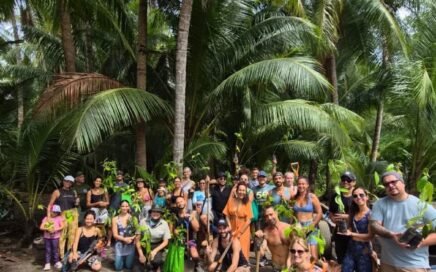
Restoring Nature with GrandiOSA
Grandiosa Costa Rica has a clear goal: to plant 4.000 trees per year. In the Osa region, such reforestation efforts occur regularly, with an average of about 100 trees planted per event

What to do, Where to eat and Where to stay…
South Pacific Costa Rica Beaches
Looking for business directories, maps or other printouts? We’ve got that too!
Dare to Discover and Enjoy…
Check out…
Need help planning your next trip to Costa Rica? We look forward to help you!
Email: carlos@ballenatales.com
Phone: +(506) 8946 7134 or +(506) 8914 1568