
Jingle bells of the Snake World – the Neotropical Rattlesnakes
Author: Roel de Plecker
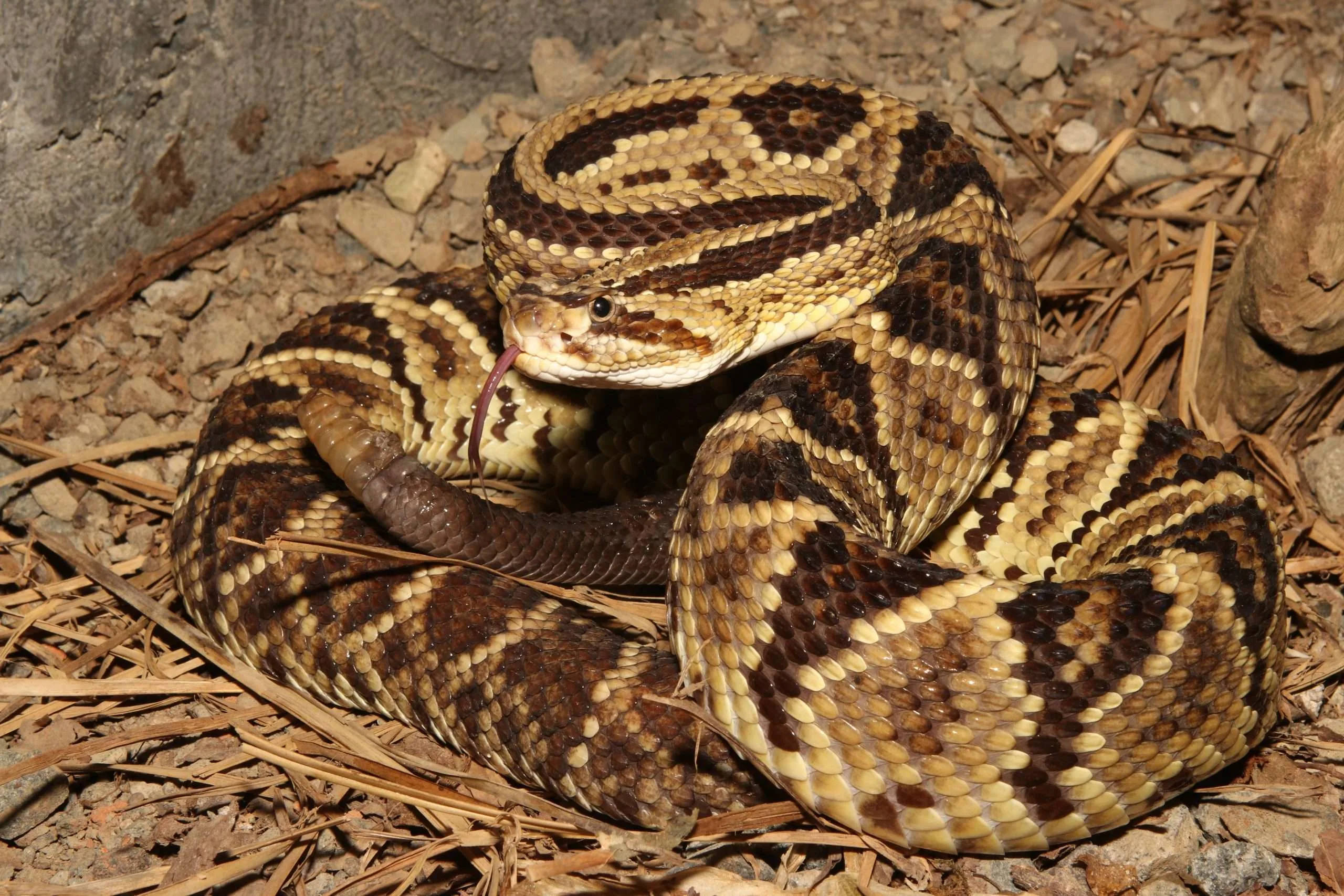
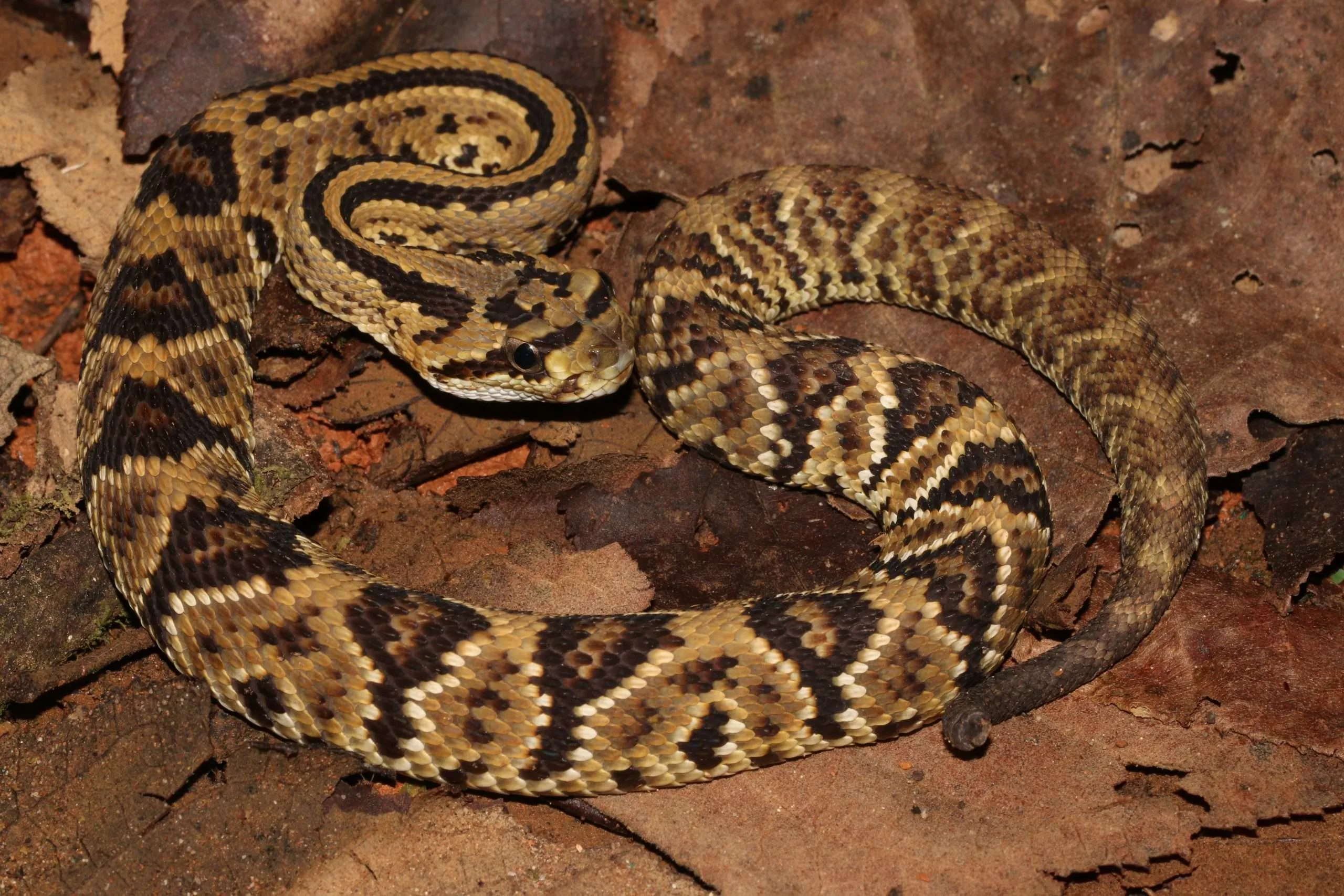
Tropical Rattlesnakes, does this word ring a bell to you? I think everyone has heard of them or seen them on television, stealing the show in cowboy movies or nature documentaries. Famous for their rattling tail tip, actually modified scales, being a series of hollow interlocking segments made out of keratin (the same substance as your fingernails.) Specialized muscles in the snakes’ tail shake the rattle at a very high frequency, thereby producing the unmistakable sound. One of several hypotheses for these pitvipers’ rattle’s origin is that it evolved as an aposematic warning for predators that the snake is venomous. Another assumption is that the rattling tail distracts predators from attacking the more vulnerable head of the animal. Defensive tail vibration is quite common in venomous and non-venomous snakes. Examples are bushmasters, lancehead pitvipers, tiger rat snakes, etc. Also, it can be that the snakes lure their prey with their tail. This ‘caudal luring’ has been observed in several other species of snakes. There is the popular misbelieve that you can determine the age of the snake by counting these segments. However, every time the snake shed’s its skin, a new segment is added. Snakes shed several times a year, they grow out of their old skin, and they grow faster when they are young. The baby rattlesnakes get born with just a single button, and every time they shed, they get one extra. Also sometimes rattles do break off when getting too large. |

Several species of rattlesnakes are found from North America, throughout Central America (with Mexico having the most species), and all the way down through South America to Northern Argentina. These neotropical snakes live in a wide variety of habitats throughout their range, from deserts at sea level to alpine cloud forests up to 4.000 meters of elevation. All rattlesnake species are pitvipers; they are venomous and give birth to live young. Like all venomous snakes, they get born with fangs and venom glands, natural born killers. In Costa Rica, only one species of rattlesnake can be found, being the Neotropical rattlesnake or Crotalus simus. It occurs in the drier regions of the country, being Guanacaste and Nicoya’s dry forests. The Neotropical rattlesnake can grow to 1.8 meters, with males being bigger than females. Ritual combat between males has been observed. In this combat, no fangs nor venom are used, but the males raise their heads high and start wrestling with each other, the strongest one trying to push its opponent to the ground. After a while, the loser of the fight slitters away, while the stronger male will mate the female that has been observing the show. Neotropical rattlesnakes are mostly nocturnal and terrestrial, however, you can see them, as well, on lower tree branches. They feed primarily on small mammals. These rattlesnakes are absent from our Southern Pacific coast, but you can see them at Parque Reptilandia. |
Free Costa Rica Magazine #101
Ballena Tales is an essential free digital magazine and travel guide in Costa Rica, valid for travelers, residents,
Restoring Nature with GrandiOSA
Grandiosa Costa Rica has a clear goal: to plant 4.000 trees per year. In the Osa region, such reforestation efforts occur regularly, with an average of about 100 trees planted per event

Ancestral Beauty More Than a Store, A Living Community
Located in the heart of Uvita, Ancestral is not just a boutique. A place for the community – something invisible begins to awaken.

Neuroplasticity and Migration
Neuroplasticity and Migration: The Science Behind Your Brain’s Remarkable Adaptation By Dra. Nikole Solano Vargas A Medical Perspective on What Really Happens When You Move to a New Country Have you ever stood in line […]
Biostimulators and exosomes: new strategies for skin rejuvenation
Biostimulators are injectable agents that stimulate the production of collagen and elastin, essential proteins responsible for skin structural integrity.
From gardening in Austria to gardening in paradise
From gardening in Austria to gardening in paradise Author: Elisabeth Frankel EDITORS’ NOTE: Dear readers, We are proud to include this wonderful article in this edition. Ms. Frankel contacted us to say that she had […]
Mercado Bahia Ballena: Discover Costa Rica´s Diversity
Mercado Bahia Ballena: Discover Costa Rica´s Diversity Author: Evi Heine Every Wednesday and Saturday from 8 a.m. to 1 p.m., a vibrant market takes place at El Mercado de Bahía Ballena in Uvita, offering […]
Uvita: a hidden gem
Uvita Uvita, a captivating coastal town on Costa Rica’s pristine Pacific shores, invites you to a perfect fusion of nature, adventure, and serenity. With its lush rainforests and stunning beaches, Uvita is a hidden gem […]
Kamel and the Kuni Gallery: Planting Roots Through
Discover Kuni Gallery, where Boruca artist Kamel González Rojas brings Costa Rica’s indigenous heritage to life through art.
What to do, Where to eat and Where to stay…
- Activities and Tours
- Whale Watching Tour
- Natural Attractions
- Marino Ballena National Park
- Restaurants
- Hotels and Accommodations
South Pacific Costa Rica Beaches,
Looking for business directories, maps or other printouts? We’ve got that too!
Dare to Discover and Enjoy…
Check out…
Need help planning your next trip? Let us help you with your Costa Rica vacations!
Email: carlos@ballenatales.com
Phone: +(506) 8946 7134 or +(506) 8914 1568
Skype: ballenatalestravel