Fast and agile Tiger ratsnakes: puffing but not bluffing
Author: Roel de Plecker.
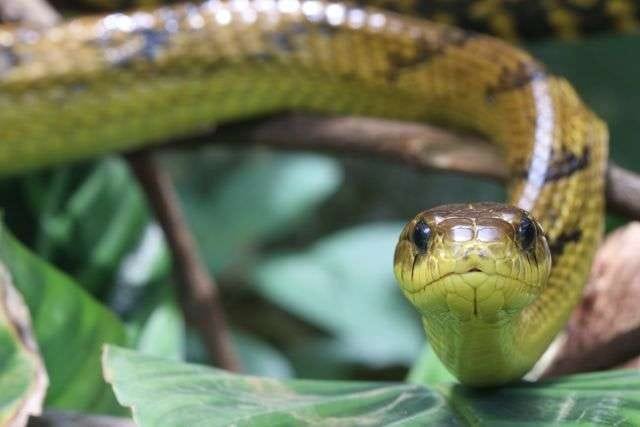
Fast and agile are the two words for describing the beautiful tiger ratsnakes (Spilotes pullatus). This name refers to their distinctive black and yellow tiger-like pattern. Although some adult individuals are almost entirely black, others from dry forests, are seemingly more yellow, this to blend in more to their environment.
They have a wide distribution, from southern Mexico to Argentina, in Costa Rica on the Caribbean versant and the Pacific side. They are sometimes seen in gardens, in lowland rainforests, lowland dry forests, forest edges, in savannas, even in swamps or simply crossing roads, and when disturbed, they move at high speed showing only a glimpse of them. But once in a while, you can observe them basking in the morning sunlight hanging out on branches and the treetops.
These diurnal species like to chase their prey, this being mostly mammals but also lizards, birds, and bats are on its menu. They are a non-venomous species. Instead of constricting its prey, they mainly crush it to death by pushing it against rocks or branches. Sometimes, they swallow their prey alive, head first, and grab them with their powerful bites. Like most snakes, they will rather flee when disturbed.
When cornered, these animals become impressive opponents! First of all, they will inflate their throats and front part of their body, exposing the black skin between the scales, which makes the dark body markings even bigger caused by lateral compression of the body. They will move their tongue slowly in and out of their mouth while vibrating their tail strongly. If this doesn’t help back you off, they will puff themselves more up, lift their front body from the ground (or branch), and repeatedly strike.

Some individuals reach a length of 2.5 meters. Another species from South America, the Amazon puffing snake (Spilotes sulphureus) can even reach a length close to 3 meters. Both snake species are oviparous, meaning they lay eggs. Clutches can have up to 10 eggs laid in the dry season and the young hatch at the start of the rainy season. Hatchlings have a more banded pattern, and this fades when they get older. Neonates of tiger rat snakes measure approximately 50 cm in total length.
The Amazon puffing snakes have a more yellowish to creamy coloration. The lower part of the body and tail are greyish brown like their name reveals they have the same impressive defensive display as our native puffing tiger rat snakes.
Interestingly, a study showed that the species from South America does have a venom gland and enlarged teeth at the back of its mouth, proving this snake being a rear-fanged species. This adaptation allows the animal to kill and consume larger prey. You can admire both of these species at Parque Reptilandia in totally remodeled enclosures!
What to do, Where to eat and Where to stay…
South Pacific Costa Rica Beaches
Looking for business directories, maps or other printouts? We’ve got that too!
Dare to Discover and Enjoy…
Check out…
Need help planning your next trip to Costa Rica? We look forward to help you!
Email: carlos@ballenatales.com
Phone: +(506) 8946 7134 or +(506) 8914 1568
Skype: ballenatalestravel
Costa Rica Free Magazine 102 Whales Season
With our usual enthusiasm, we proudly present digital edition #102 of Ballena Tales Free Magazine.

Green and Clean Home Maintenance Inside and Out
Home maintenance requires a lot of time, and in today’s fast-paced world, the demands of professional responsibilities and family life leave little room for it.

Fractional Plasma: A Modern Approach to Skin Renewal
Fractional plasma rejuvenation uses ionized gas or plasma to deliver controlled thermal energy to the skin

Restoring Nature with GrandiOSA
Grandiosa Costa Rica has a clear goal: to plant 4.000 trees per year. In the Osa region, such reforestation efforts occur regularly, with an average of about 100 trees planted per event
Ancestral Beauty More Than a Store, A Living Community
Located in the heart of Uvita, Ancestral is not just a boutique. A place for the community – something invisible begins to awaken.
Neuroplasticity and Migration
Neuroplasticity and Migration: The Science Behind Your Brain’s Remarkable Adaptation By Dra. Nikole Solano Vargas A Medical Perspective on What Really Happens When You Move to a New Country Have you ever stood in line […]